Pipeline
Human hand–object motion guides robot tracking in simulation. The resulting robot motion is then replayed on hardware.
Simulation
Drag the divider to compare MANO and Wuji; select View 3D to explore.
 Pour into a Beaker
 Lamp Extinguishing
 Whiteboard Writing
 Stirring
 Scooping
 Writing on a Whiteboard
 Scooping into a Bowl
 Spreading on Bread
 Writing on Paper
 Using a Computer Mouse
 Uncapping a Teapot
 Shaking a Conical Flask
 Lighting an Alcohol Lamp
 Moving a Blue Teacup
 Taking Out a Fork
 Heating a Beaker
 Shaking a Test Tube
 Pressing a Scale Button
 Racking a Tube with a Holder
 Racking a Glass Rod
 Removing a Test Tube
 Placing a Donut on a Saucer
 Placing a Cup on a Scale
 Moving a Tripod
 Holding a Kitchen Knife
 Putting Tape in a Box
 Moving a Striped Bottle
 Moving a Toothbrush
Method

Key insight. The bottleneck in training a generalist dexterous policy is collecting useful interaction experience. DexMimic shifts the focus beyond reward design: Value-Guided Reset Allocation shapes this experience by adapting the initialization distribution alongside policy learning.
Results
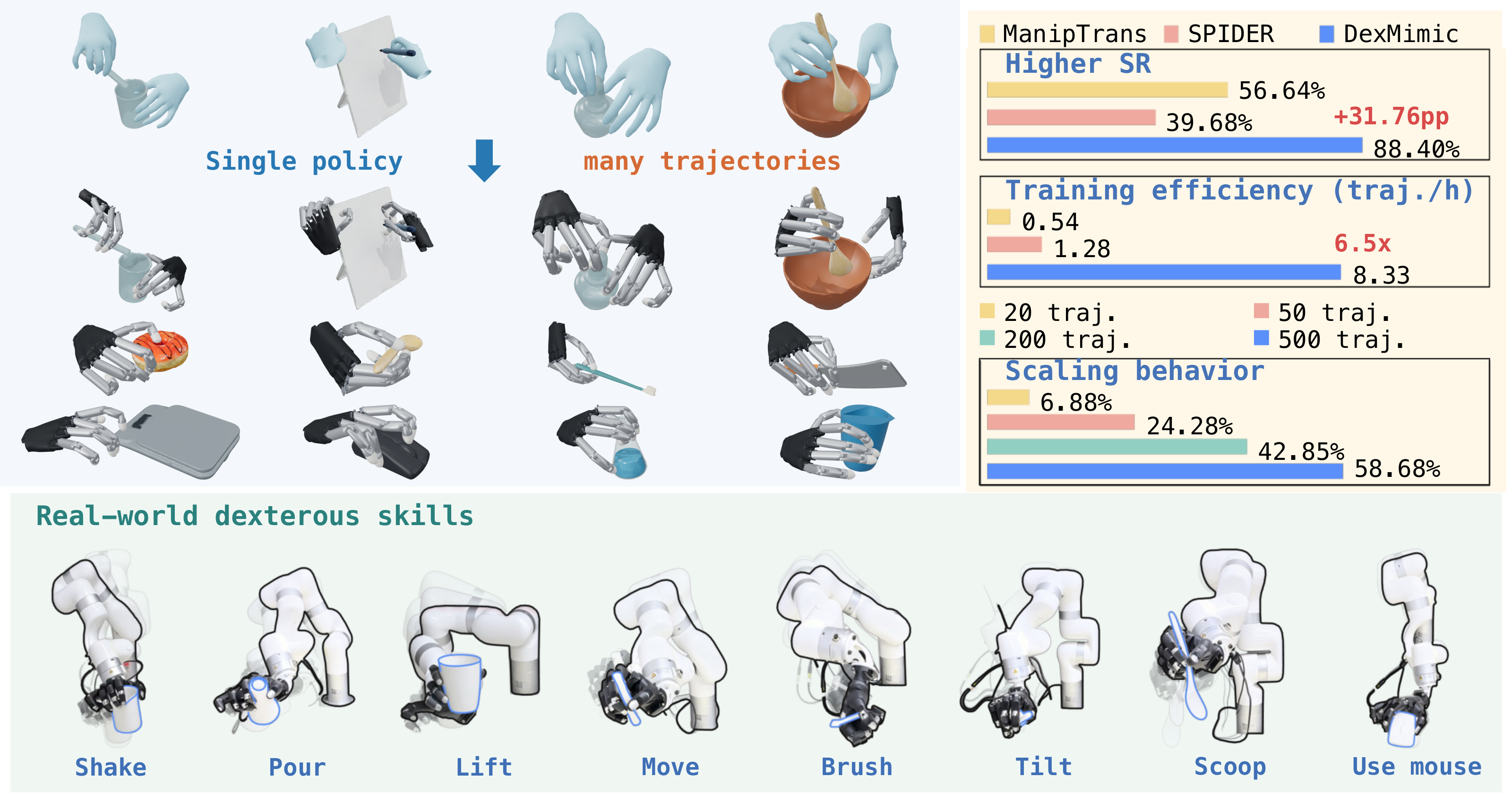
One generalist policy achieves higher tracking success and lower average training cost than trajectory-specific methods. Scaling co-training strengthens transfer to unseen motions and objects.
50 challenging bimanual trajectories from OakInk-V2 and HOT3D. Time is the average training or optimization time per trajectory; DexMimic's joint-training time is divided by 50. All methods share the evaluation initial states, rollout counts and success criteria. Green cells indicate the best value in each column.
Scaling & Generalization
More training trajectories improve zero-shot transfer. Hover over a bar to see its exact success rate.
L1 · Similar motionsL2 · Unseen motionsL3 · Unseen objects
L1: similar trajectories with seen objects. L2: unseen trajectories with seen objects. L3: trajectories with unseen objects. Policies are frozen during evaluation.
Fast Adaptation
Fine-tuning compared with training from scratch on an unseen trajectory.
Fine-tuningFrom scratch
5.3×faster to reach 80% Training SR
0.24 h vs. 1.27 h
0.24 h vs. 1.27 h
Realworld
Real-robot clips are trimmed and time-scaled to match the simulation.
Mouse manipulation
Spoon manipulation
Roll manipulation
Beaker shaking
Test-tube pouring
Test-tube shaking
Flask shaking
Introduction
Achieving human-like dexterous manipulation remains a central challenge in robotics. Learning from human hand–object interaction (HOI) datasets offers a promising pathway to diverse dexterous skills, yet existing physics-based approaches train specialist policies for individual trajectories, thereby limiting skill reuse at scale. We introduce DexMimic, a generalist dexterous hand–object tracking policy jointly trained across diverse HOI trajectories. Efficient joint training requires allocating each rollout to both an undertrained phase and a starting state that supports continued tracking. DexMimic realizes this insight through Value-Guided Reset Allocation, which adapts the initialization distribution online to prioritize difficult phases and select reset states with higher expected tracking returns.